
Drinking Fountain / Water Coolers
PFAS in Drinking Water: What Facility Managers Need to Know + Filtration Solutions
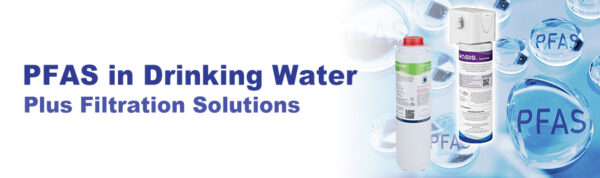
As a facility manager, ensuring the safety and well-being of your building’s occupants is always a top priority. One concern receiving increased attention is the presence of PFAS, also known as “forever chemicals,” in drinking water.
These synthetic chemicals have been used in everything from nonstick cookware to firefighting foams and have become a growing concern due to their persistence in the environment and potential health effects.
Fortunately, drinking fountain manufacturers like Elkay and Oasis offer filtration products designed to reduce certain PFAS chemicals in drinking water. Some replacement cartridges can be installed in compatible existing filtration systems, making it possible to upgrade filtration without replacing the entire drinking fountain or bottle filling station.
Read on to learn what PFAS are, why they matter, and what filtration options are available for commercial facilities from top drinking fountain manufacturers Elkay and Oasis.
What Are PFAS, or “Forever Chemicals”?
PFAS stands for per- and polyfluoroalkyl substances, a large group of synthetic chemicals that have been used in industry and consumer products since the 1940s.
PFAS have been used in the manufacturing of:
- Nonstick cookware
- Water-repellent clothing
- Stain-resistant fabrics and carpets
- Certain cosmetics
- Some firefighting foams
- Food packaging and other products designed to resist grease, water, and oil
PFAS are commonly referred to as “forever chemicals” because many break down very slowly and can remain in the environment for long periods of time.
Two of the most widely studied PFAS chemicals are:
- PFOA: Perfluorooctanoic acid
- PFOS: Perfluorooctane sulfonic acid
Studies have linked exposure to certain PFAS with potential health effects, including increased cholesterol, reduced immune response, reproductive and developmental effects, and increased risk of certain cancers. PFAS can enter the body through contaminated drinking water, food, and other environmental sources. According to a U.S. Geological Survey study, at least one PFAS chemical was detected in approximately 45% of the tap water samples tested across the United States.
For additional information, visit the EPA’s PFAS information page.
PFAS in Drinking Water: What Facility Managers Should Know
In April 2024, the Environmental Protection Agency (EPA) finalized the first national drinking water regulation for several PFAS chemicals, including PFOA and PFOS.
The original rule established maximum contaminant levels of 4.0 parts per trillion for PFOA and PFOS individually. Federal PFAS drinking water requirements and implementation timelines have continued to evolve, so facility managers should consult the EPA and their state drinking water authority for current requirements.
Facilities concerned about PFAS in their drinking water should consider the following steps:
- Review local water quality reports. Contact your water utility or review its Consumer Confidence Report for available PFAS testing results.
- Determine whether additional testing is necessary. Facilities using private wells or other independent water supplies may need to arrange testing through a qualified laboratory.
- Evaluate existing drinking water filtration systems. Identify the filters currently installed in drinking fountains, water coolers, and bottle filling stations.
- Consider certified PFAS filtration products. Look for filters with independently verified reduction claims for the specific contaminants of concern.
- Maintain a regular filter replacement schedule. Follow the manufacturer’s replacement intervals to maintain filtration performance.
Drinking Fountain Filters Designed to Reduce PFAS
Several major drinking fountain manufacturers offer replacement filters designed to reduce PFAS in drinking water.
Elkay and Oasis both offer filtration products that address PFAS contamination. Depending on the equipment already installed, facilities may be able to upgrade to a compatible PFAS-reducing cartridge rather than replace the entire drinking fountain or bottle filling station.
However, not all filters are interchangeable, and different products have different contaminant reduction certifications. Always verify compatibility and filtration claims before ordering.
Elkay WaterSentry 71300C PFOA/PFOS Replacement Filter
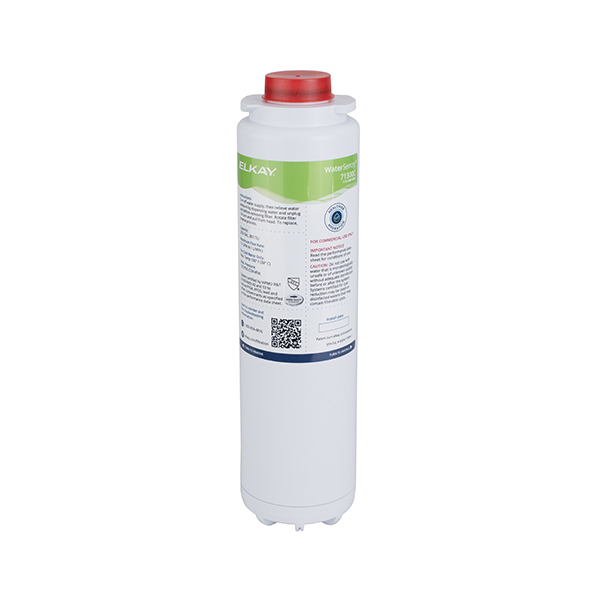
Elkay’s WaterSentry 71300C replacement filter is designed to reduce PFOA and PFOS, two prevalent PFAS chemicals, along with several other drinking water contaminants.
This filter is designed for compatible Elkay enhanced ezH2O bottle filling stations.
Elkay WaterSentry 71300C Features:
- Tested and certified to NSF/ANSI Standards 42 and 53 for specified contaminant reduction claims, including PFOA and PFOS, lead, Class I particulates, cysts, and chlorine taste and odor
- 2,250-gallon filter capacity
- Replace every 2,250 gallons or one year after installation, whichever comes first
- Quick-disconnect, quarter-turn installation
- Automatic inlet shutoff valve that closes when the filter is removed
- Dimensions: 3-5/16″ W x 3-5/16″ D x 11-5/8″ H
- Elkay model number: 71300C
- Equiparts part number: #20339
For facilities with compatible Elkay filtration systems, the WaterSentry 71300C may provide a straightforward way to add PFOA/PFOS reduction capabilities.
If your drinking fountain or bottle filling station does not already have the appropriate filtration components, additional installation parts or a complete filtration kit may be required.
Shop Elkay WaterSentry 71300C PFAS Replacement Filter – Part #20339
Oasis Total PFAS Filtration Products
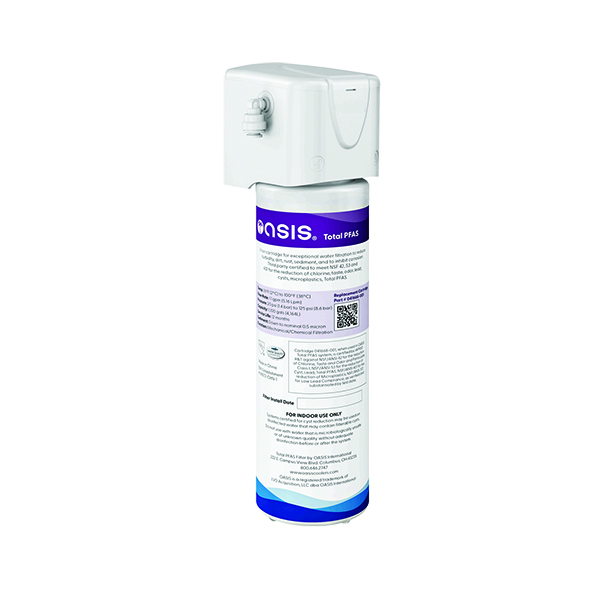
Oasis also offers filtration options designed to reduce PFAS in drinking water, including replacement cartridges and retrofit filtration kits.
Oasis Total PFAS Filter Retrofit Kit
- Manufacturer model: 041253-005
- Equiparts part number: #22344
Shop Oasis Total PFAS Filter Retrofit Kit – Part #22344
Oasis Total PFAS Replacement Filter Cartridge
- Manufacturer model: 014668-001
- Equiparts part number: #22348
Shop Oasis Total PFAS Replacement Filter Cartridge – Part #22348
Choosing the Right PFAS Filter for Your Facility
Before purchasing a PFAS replacement filter, identify the manufacturer and model number of your drinking fountain, water cooler, or bottle filling station.
You’ll also want to consider the contaminants the filter is certified to reduce, its rated capacity, and whether your existing system supports the replacement cartridge.
Keep in mind that a filter certified to reduce PFOA and PFOS is not necessarily certified to reduce every PFAS chemical.
For additional information about Elkay filter options, review our Elkay and Oasis Filter Comparison Charts.
Equiparts carries a wide selection of drinking fountain filters, replacement cartridges, filtration kits, and repair parts from leading manufacturers, including Elkay and Oasis.
If you need assistance identifying the correct PFAS filter for your facility, contact an Equiparts representative at 1-800-442-6622.